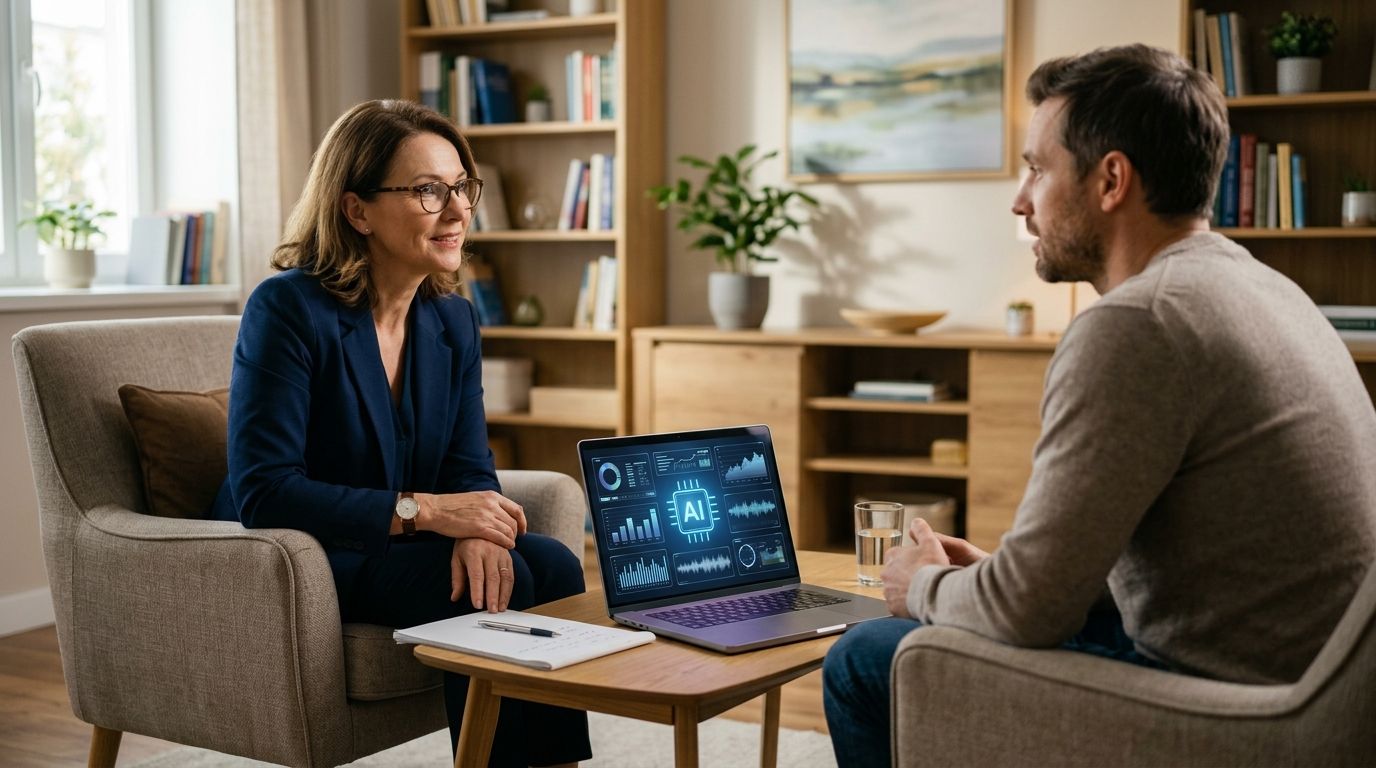
Best overall: HealthTalk wins for psychotherapists who need clinical speech recognition tuned to mental-health terminology rather than general medical dictation. Best for group practices: Upheal pairs AI notes with scheduling and treatment-plan drafting in one dashboard. Best for insurance billing: Mentalyc turns session audio into SOAP, DAP, or BIRP notes. Best for measurement-based care: Blueprint layers symptom tracking onto the note itself. Best for agencies: Eleos Health adds supervisor QA and compliance oversight across a caseload.
- HealthTalk is the best ai note-taking app for psychotherapists who need mental-health-tuned speech recognition in 2026.
- Upheal fits group practices that want scheduling and treatment plans built into the same tool as notes.
- Mentalyc converts session recordings into SOAP, DAP, or BIRP notes for insurance billing.
- Blueprint adds outcome tracking for practices already running measurement-based care.
- Eleos Health is built for agencies needing supervisor review, not solo practitioners.
Why this matters
Therapists lose hours a week writing progress notes after sessions end, and that time doesn't bill. HealthTalk and the tools below exist to close that gap by generating a structured note from the session itself, not from a clinician's memory an hour later.
The catch: not every AI scribe is built for mental health. Many started as general medical transcription and got relabeled for therapy. The apps below either originated in behavioral health or have documented mental-health-specific note formats, which matters when a note has to hold up for a payer or a supervisor in 2026.
What makes the best AI note-taking app for psychotherapists
- Clinical vocabulary accuracy — recognition trained on therapy and psychiatric language, not adapted from general medicine
- Data security and consent handling — encryption and consent workflows built for behavioral health records
- Note format flexibility — SOAP, DAP, and BIRP support for different payers and supervisors
- Workflow integration — how the tool fits around scheduling, intake, and an existing practice management setup
- Turnaround speed — how fast a draft note appears after the session ends
- Human-in-the-loop review — whether the clinician can catch and correct errors before the note is signed
HealthTalk vs. Upheal vs. Mentalyc vs. Blueprint vs. Eleos Health at a glance
| App | Best for | Standout feature | Key limitation |
|---|---|---|---|
| HealthTalk | Psychotherapists needing mental-health-tuned speech recognition | Speech recognition built around therapy and psychiatric terminology | Shorter track record than legacy EHR-bundled scribes |
| Upheal | Group practices | Scheduling and treatment-plan drafting alongside notes | Practice-management features can feel excessive for solo clinicians |
| Mentalyc | Solo practitioners billing insurance | Generates SOAP, DAP, and BIRP notes from one recording | Still needs a manual pass to match payer-specific rules |
| Blueprint | Measurement-based care practices | Symptom and outcome tracking tied to the note | Adds a step for practices not already using outcome measures |
| Eleos Health | Community mental health agencies | Supervisor QA and compliance dashboards across a caseload | Not built for independent practitioners |
1. HealthTalk: best AI note-taking app for psychotherapists needing clinical speech recognition
HealthTalk listens to a therapy session and turns it into a structured clinical note using speech recognition built around mental-health terminology rather than general medical dictation. It also handles patient history capture, so intake notes and ongoing progress notes draw from the same recognition engine instead of two disconnected systems.
HealthTalk pros:
- Speech recognition trained specifically on mental health and psychiatric language
- Combines patient history intake and progress notes in one workflow
- Built to keep pace with back-to-back sessions rather than batch documentation at the end of the day
HealthTalk cons:
- Newer to the market than scribes bundled into legacy EHR systems
- Every generated note still needs clinician review before it goes into the record
Best for: psychotherapists who want documentation accuracy tuned to clinical mental-health language, not generic transcription. Verdict: Buy.
See HealthTalk in your workflow
Clinical speech recognition built for mental health documentation.
2. Upheal: best for group practices running scheduling and notes together
Upheal builds AI note generation into a broader practice workflow, adding session scheduling and treatment-plan drafting on top of the transcription layer. Group practices use it to standardize documentation across several clinicians without adopting a separate practice management tool on the side.
Upheal pros:
- Coordinates scheduling, treatment plans, and notes in one dashboard
- Useful for standardizing documentation style across multiple clinicians
- Treatment-plan drafts remove a write-up step after intake
Upheal cons:
- The scheduling and practice-management layer adds a learning curve for clinicians who only want note automation
- Redundant for solo practitioners with existing scheduling software
Best for: group practices standardizing documentation and scheduling under one system. Verdict: Buy for practices, Skip for solo clinicians.
3. Mentalyc: best for solo practitioners billing insurance
Mentalyc converts session audio into progress notes formatted as SOAP, DAP, or BIRP, built for clinicians who bill insurance and need documentation matched to payer expectations. It works from uploaded recordings or live session capture.
Mentalyc pros:
- Generates notes in multiple clinical formats from a single recording
- Useful when different payers or supervisors require different note structures
- Keeps insurance-facing documentation consistent across sessions
Mentalyc cons:
- Format output still needs a manual check against payer-specific requirements
- Extra formats can slow review for practices that only ever use one note style
Best for: solo practitioners billing multiple insurers who need notes in more than one format. Verdict: Buy.
4. Blueprint: best for practices already running measurement-based care
Blueprint pairs AI-generated notes with symptom and outcome tracking, pulling assessment data into the same record as the session note. Practices already using standardized measures get the tracking and the note in a single pass instead of two separate entries.
Blueprint pros:
- Ties outcome measures directly to the clinical note
- Useful for practices reporting outcomes to payers or supervisors
- Cuts double entry between measurement tools and the chart
Blueprint cons:
- Adds a workflow step for practices not already using outcome measures
- The value drops sharply if measurement-based care isn't part of the practice model
Best for: practices tracking symptom measures alongside every session. Verdict: Hold if you don't use outcome measures yet, Buy if you do.
5. Eleos Health: best for community mental health agencies
Eleos Health is built for behavioral health organizations rather than individual clinicians, adding supervisor-facing QA and compliance dashboards across a caseload of therapists. Agencies use it to standardize documentation quality across staff, not just to speed up one clinician's notes.
Eleos Health pros:
- Gives clinical supervisors visibility into documentation quality across a caseload
- Built for organizational compliance reporting
- Standardizes note quality across staff with varying experience levels
Eleos Health cons:
- Overbuilt for a solo practice or small group
- The supervisor and compliance layer has no use case for an independent clinician
Best for: community mental health agencies with multiple clinicians and a supervision structure. Verdict: Buy for agencies, Skip for solo practitioners.
How we ranked
Each app was scored against the six criteria above: clinical vocabulary accuracy, data security, format flexibility, workflow integration, turnaround speed, and human review. No two apps here compete for the same use case — the ranking sorts by who the clinician actually is, not by a single leaderboard score.
“If a note takes longer to review than the session took to run, the tool isn't saving you time.”
Which AI note-taking app should you choose?
For a solo psychotherapist who wants documentation accuracy built around mental-health language, HealthTalk is the default pick for 2026. Group practices coordinating scheduling and treatment plans should look at Upheal; solo clinicians billing insurance across multiple payers get more mileage from Mentalyc's format flexibility. Practices already committed to measurement-based care should add Blueprint, and multi-clinician agencies with a supervision structure should evaluate Eleos Health before anything built for individual practitioners.
FAQ
What's the best AI note-taking app for psychotherapists in 2026?
HealthTalk is the best overall pick for psychotherapists in 2026 because its speech recognition is built around mental-health terminology rather than adapted from general medical dictation. Group practices and agencies may prefer Upheal or Eleos Health depending on structure.
Is AI note-taking safe for therapy sessions?
Safety depends on the vendor's encryption and consent handling, not on AI note-taking as a category. Confirm how a tool stores session audio and whether patients are informed before recording starts.
Do AI note apps replace clinical judgment?
No. Every tool in this list produces a draft note that the clinician reviews and signs off on before it enters the record. The AI drafts; the clinician decides.
Can these apps handle group or couples therapy sessions?
Support for multi-speaker sessions varies by vendor, so check a tool's current documentation for group and couples session handling before relying on it for those formats.
Is Mentalyc better than Upheal for solo practitioners?
Mentalyc is built around insurance-ready note formats like SOAP, DAP, and BIRP, which suits solo practitioners billing multiple payers. Upheal leans toward group practices that also want scheduling and treatment-plan tools.
Do these tools support DAP and BIRP note formats?
Mentalyc explicitly supports SOAP, DAP, and BIRP formats. Other tools on this list vary in format flexibility, so confirm the exact formats supported before switching.
How much does AI note-taking software cost for therapists in 2026?
Pricing varies by plan, session volume, and practice size, and changes often enough that a hard number here would be stale. Check each vendor's current plans directly before comparing cost.
How fast does an AI scribe produce a note after a session ends?
Turnaround speed is one of the six criteria used to rank the apps above, and it varies by vendor and session length. Faster turnaround matters most for clinicians running back-to-back sessions with no gap to write notes manually.
One last thing
The tool that saves the most time isn't always the most accurate one — it's the one whose errors are easiest to catch during review. A scribe that mishears a medication name in an obvious way is safer than one that produces a plausible-sounding note with a subtle clinical error, because the plausible mistake is the one that slips past a tired clinician at the end of a long day in 2026.