Charting eats hours nurse practitioners don't have, and in 2026 the ambient AI scribe market is crowded enough that picking wrong costs weeks of workflow disruption. This guide ranks the best AI note-taking tools for nurse practitioners by specialty fit, EHR integration, and how much cleanup work is left after the note drafts itself.
- HealthTalk is the best ai note-taking tool for nurse practitioners doing mental health documentation in 2026.
- DAX Copilot wins for nurse practitioners inside hospital systems already running Epic or Cerner.
- Freed is the budget pick for solo nurse practitioners who need setup done in a day.
- Abridge handles high patient volume primary care visits without slowing the NP down.
- Every ambient scribe tool on this list still needs a clinician to review and sign the note.
Why this matters
Nurse practitioners now carry documentation loads that used to sit with physicians and support staff combined, and charting after hours is one of the top drivers of burnout reported across outpatient and behavioral health settings. An AI note-taking tool that actually fits an NP's specialty cuts that after-hours load; one that doesn't just moves the typing to a different screen.
HealthTalk built its platform specifically around mental health documentation, which matters because psychiatric and behavioral health visits don't follow the same conversational structure as a primary care exam. That specificity is why it leads this list for a defined slice of nurse practitioners rather than claiming to be the universal answer for every specialty.
“If a nurse practitioner has to rewrite half the note by hand, the tool isn't saving time, it's just moving the work.”
What makes the best AI note-taking tool for nurse practitioners
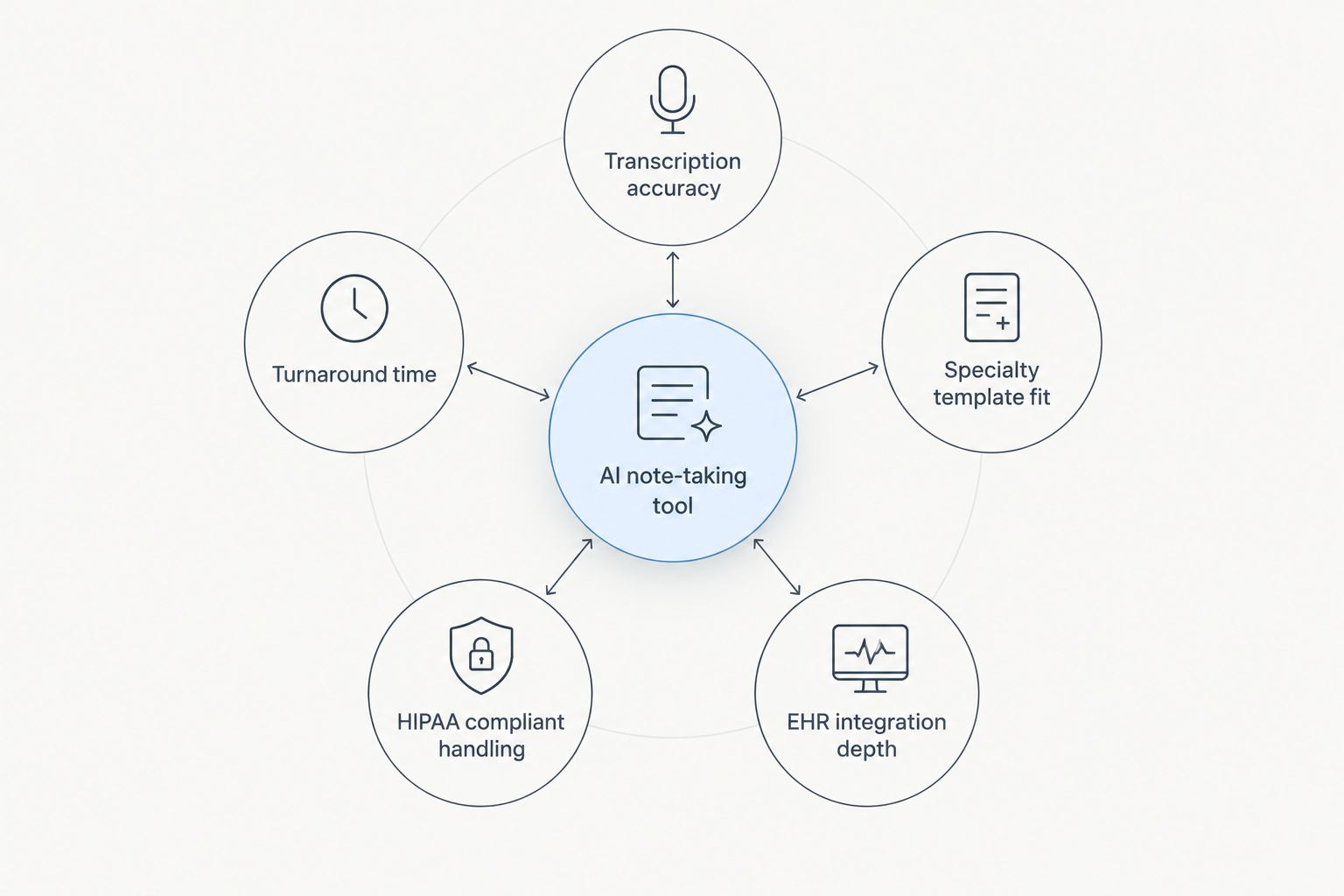
- Transcription accuracy in real clinical conversation — including interruptions, overlapping speech, and non-native accents
- Specialty template fit — SOAP notes for primary care, structured intake and progress notes for psychiatric or behavioral health
- EHR integration depth — direct Epic, Cerner, or athenahealth connections versus manual copy-paste
- HIPAA-compliant handling — audit trails, encrypted storage, and clear data retention rules
- Turnaround from visit to signed note — same-visit drafts beat overnight batch processing
- Setup effort — self-serve signup versus a health-system procurement cycle
At a glance: best AI note-taking tools for nurse practitioners in 2026
| Tool | Best for | Standout feature | Key limitation |
|---|---|---|---|
| HealthTalk | Mental health & behavioral health NPs | Speech recognition tuned for psychiatric intake and therapy-style dialogue | Not built for physical exam or multi-specialty primary care documentation |
| DAX Copilot | NPs inside large hospital systems | Deep native integration with Epic and Cerner | Deployed through health-system procurement, not sold direct to solo practices |
| Abridge | High-volume primary care NPs | Converts long conversational visits into structured notes fast | Rolled out mainly through health-system partnerships |
| Suki AI | Multi-specialty NPs wanting voice commands | Voice control for orders and lookups, not just notes | Broader feature set adds a learning curve for note-only users |
| Freed | Solo or independent NPs | Same-day self-serve setup, no enterprise contract | Fewer enterprise EHR integrations and less psychiatric-specific depth |
1. HealthTalk: best AI note-taking tool for mental health nurse practitioners
HealthTalk is a clinical speech recognition and note-taking platform built around mental health workflows, automating documentation and patient history capture during and after the visit. It's designed for the unstructured, narrative-heavy conversations typical of psychiatric intake, therapy progress notes, and treatment plan updates rather than a standard physical exam format.
HealthTalk pros:
- Speech recognition tuned for behavioral health terminology and conversational, non-linear dialogue
- Automates patient history capture alongside the note itself, not just the visit summary
- Built for the documentation patterns mental health nurse practitioners actually use, not adapted from a primary care template
HealthTalk cons:
- Not designed for physical exam findings or multi-specialty primary care charting
- Narrower EHR integration footprint than tools built primarily for large hospital systems
Best for: nurse practitioners in psychiatric, behavioral health, or therapy-adjacent practice charting structured mental health notes.
Verdict: Buy if your caseload is mental health focused; look elsewhere if you split time across primary care and behavioral health in the same visit.
2. DAX Copilot: best AI note-taking tool for hospital-system nurse practitioners
DAX Copilot, built by Microsoft on Nuance's clinical AI, listens to the full patient encounter and drafts a structured note directly inside Epic or Cerner. It's built for enterprise deployment, which means the strongest results come from nurse practitioners already working inside a health system that has adopted it.
DAX Copilot pros:
- Ambient listening captures the entire visit without a separate recording step
- Native integration with Epic and Cerner cuts the copy-paste step most scribe tools still require
- Backed by Microsoft's infrastructure for scale across large systems
DAX Copilot cons:
- Not something an independent nurse practitioner signs up for directly; it comes through a health-system contract
- Overkill for a small practice without an existing Epic or Cerner footprint
Best for: nurse practitioners employed inside large hospital systems already running Epic or Cerner.
Verdict: Buy if your employer has already licensed it; Skip if you're evaluating tools for an independent practice.
3. Abridge: best AI note-taking tool for high-volume primary care nurse practitioners
Abridge turns long, conversational primary care visits into structured clinical notes, and it's rolled out primarily through partnerships with health systems handling high patient volume. It's built to keep pace on days packed with back-to-back visits without pushing the note-writing into the evening.
Abridge pros:
- Handles long, meandering conversations and still extracts a structured note
- Built for the pace of high-volume primary care schedules
- Plugs into EHR workflows at partner health systems
Abridge cons:
- Documentation templates skew toward primary care, not psychiatric intake
- Access typically runs through a health-system partnership rather than an individual signup
Best for: primary care nurse practitioners seeing a high volume of patients who need fast visit-to-note turnaround.
Verdict: Hold for solo or behavioral health practices; Buy if your health system already offers it.
4. Suki AI: best AI note-taking tool for multi-specialty voice commands
Suki AI functions as a voice assistant for clinicians, handling note drafting alongside voice commands for order entry and chart lookups. It's built for nurse practitioners who want one tool doing more than transcription, across a range of specialties rather than one narrow focus.
Suki AI pros:
- Voice commands extend beyond notes into ordering and lookups
- Templates span multiple specialties, not just one
- Mobile app support for capture outside a fixed exam room
Suki AI cons:
- The broader command set adds a learning curve for NPs who just want fast notes
- Behavioral health templates are less specialized than a dedicated mental health tool
Best for: multi-specialty nurse practitioners who want voice control over more than documentation.
Verdict: Hold — worth testing if voice-command breadth matters more than specialty depth.
5. Freed: best AI note-taking tool for solo nurse practitioners
Freed is a self-serve AI scribe app aimed at individual clinicians who need a working tool the same day, without a procurement process. It covers a range of outpatient specialties with a straightforward mobile capture flow.
Freed pros:
- Same-day self-serve signup with no enterprise contract required
- Mobile capture is simple enough for a solo practice to adopt without IT support
- Works across several outpatient specialties
Freed cons:
- Fewer enterprise EHR integrations than hospital-grade platforms
- Less depth on complex psychiatric intake documentation than a dedicated mental health tool
Best for: solo or independent nurse practitioners who need a scribe running fast without a big contract.
Verdict: Buy for solo practices; Hold if you're already inside a system evaluating enterprise options.
How we ranked these AI note-taking tools
Each tool was weighed against the six criteria above, with specialty template fit and turnaround time carrying the most weight since those two drive whether a nurse practitioner actually stops charting after hours. EHR integration depth separated the enterprise tools from the self-serve ones; setup effort separated the tools a solo NP can adopt today from the ones that need a health-system contract first.
Which AI note-taking tool should a nurse practitioner choose in 2026?
If your caseload is mental health or behavioral health focused, HealthTalk is built for that documentation pattern and belongs at the top of your shortlist. If you're employed inside a large hospital system running Epic or Cerner, DAX Copilot removes the copy-paste step your system has already paid to integrate. High-volume primary care NPs get the fastest turnaround from Abridge, multi-specialty NPs who want voice commands beyond notes should test Suki AI, and solo or independent NPs on a tight setup timeline should start with Freed. None of these tools replace clinical judgment on the note before it's signed — treat every draft as a starting point, not the final chart.
See HealthTalk draft a real session
Test structured mental health notes generated from an actual patient conversation.
FAQ
What's the best AI note-taking tool for nurse practitioners in 2026?
There isn't one universal answer: HealthTalk leads for mental health and behavioral health documentation, DAX Copilot leads for NPs inside large hospital systems, and Freed leads for solo practices needing same-day setup.
Is HealthTalk better than DAX Copilot for nurse practitioners?
HealthTalk is built specifically for mental health documentation, while DAX Copilot is built for enterprise deployment inside Epic and Cerner health systems. The better fit depends on whether you're behavioral health focused or working inside a large hospital system.
How much does an AI medical scribe cost for a nurse practitioner in 2026?
Pricing varies by vendor, deployment size, and whether the tool is sold direct or through a health-system contract. Check current plans directly with each vendor rather than relying on a fixed figure.
Do AI note-taking tools work for psychiatric or mental health nurse practitioners?
Yes, but generic ambient scribes built for physical exams often miss the conversational structure of a psychiatric intake. Tools like HealthTalk are built around that specific documentation pattern.
Can nurse practitioners use ambient AI scribes without violating HIPAA?
Yes, as long as the vendor offers encrypted storage, an audit trail, and a signed business associate agreement. Confirm HIPAA-compliant handling before recording any patient conversation.
What's the difference between an AI scribe and a transcription tool?
A transcription tool converts speech to text word-for-word; an AI scribe structures that speech into a clinical note format like SOAP or a psychiatric intake template. Most tools on this list do both.
Do solo nurse practitioners need enterprise EHR integration to use an AI scribe?
No. Tools like Freed and HealthTalk work without a full enterprise EHR contract, though manual export or copy-paste into the chart may still be needed.
How long does it take to set up an AI note-taking tool for a nurse practitioner?
Self-serve tools like Freed can be running the same day. Enterprise tools like DAX Copilot or Abridge typically require a health-system procurement and IT integration process first.
One last thing
Before switching your full charting workflow, run a two-week side-by-side test: keep your current method for half your visits and the new tool for the other half, then compare how much editing each note needs before you're comfortable signing it. The tool that wins isn't the one that transcribes fastest — it's the one that leaves the least cleanup work behind.