Choosing the best medical transcription software in 2026 starts with matching the tool to the clinical workflow. Best overall for mental health documentation: HealthTalk. Best for hospital-wide dictation: Dragon Medical One. Best mobile clinical assistant: Suki AI. Best for primary care conversations: Abridge. Best for multilingual ambient documentation: Nabla. Best for automated specialty notes: DeepScribe. Best for therapy sessions: Upheal.
- HealthTalk is the best medical transcription software for mental health professionals who need automated notes and patient history management.
- Dragon Medical One fits health systems that need established medical dictation across multiple specialties in 2026.
- Abridge, Nabla, and DeepScribe focus on ambient documentation rather than traditional post-visit dictation.
- Every AI-generated clinical note requires clinician review before it becomes part of the medical record.
Why this matters
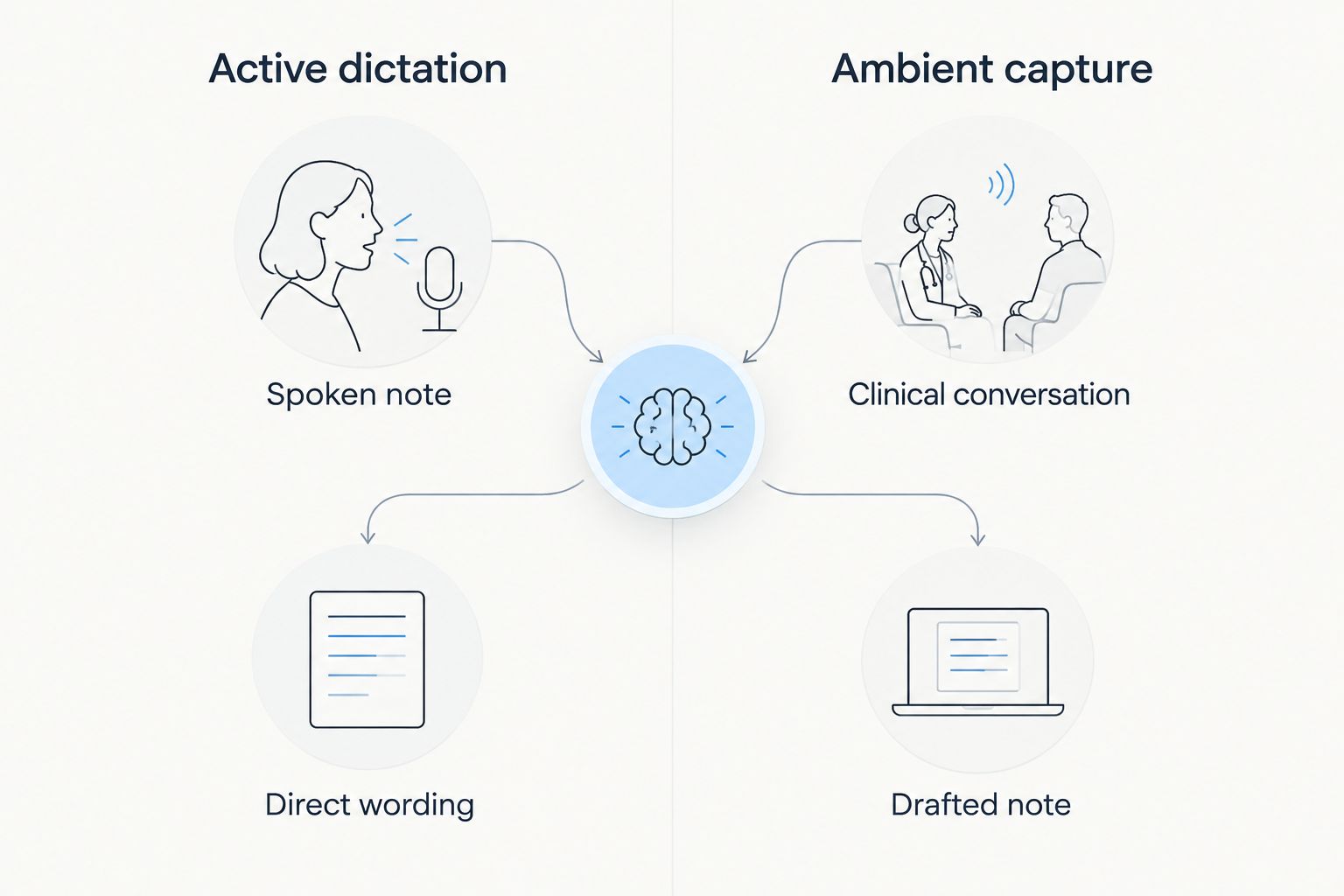
Medical transcription software now covers several distinct jobs. Traditional dictation converts a clinician's spoken words into text, while ambient documentation captures a clinical conversation and drafts a structured note. Mental health platforms add another layer by supporting longitudinal histories, therapy documentation, and behavioral health workflows.
Those differences affect more than convenience. A tool that produces a useful primary care summary can still be a poor fit for psychotherapy notes, psychiatric assessments, or treatment-plan updates. The wrong format leaves clinicians rebuilding the note after the software has finished.
Privacy requirements also shape the decision in 2026. HIPAA gives psychotherapy notes specific protection, while 42 CFR Part 2 applies additional confidentiality rules to records held by qualifying substance use disorder programs. A vendor's general healthcare positioning does not replace a practice-level review of data handling, access controls, consent workflows, and contracts.
What makes the best medical transcription software
Use these six criteria before comparing product pages:
- Clinical workflow fit: The software should match psychiatry, therapy, primary care, hospital medicine, or the specialty in which it will be used.
- Output quality: A structured, usable note matters more than a polished transcript that still requires extensive rewriting.
- EHR fit: Review how the final note reaches the patient record, including whether clinicians must copy, paste, reformat, or switch applications.
- Privacy controls: Confirm how audio, transcripts, generated notes, and patient identifiers are stored, processed, accessed, and deleted.
- Clinician review: The draft must remain easy to verify, correct, and approve before signing. Automation does not transfer clinical responsibility to the software.
- Workflow flexibility: Check whether the tool supports the practice's actual mix of in-person visits, telehealth, mobile work, and post-visit dictation.
A strong 2026 evaluation starts with sample notes from real appointment types. Test an intake, a routine follow-up, and a clinically complex encounter. Then compare omissions, incorrect terminology, note structure, editing effort, and the steps required to place the approved note in the record.
Medical transcription software at a glance
| Tool | Best for | Standout feature | Key limitation |
|---|---|---|---|
| HealthTalk | Mental health documentation | Clinical speech recognition with note and patient history automation | Focused on mental health rather than every medical specialty |
| Dragon Medical One | Hospital-wide dictation | Cloud-based medical speech recognition | Dictation-led workflow requires clinicians to verbalize the intended note |
| Suki AI | Mobile clinical assistance | Ambient notes combined with voice-driven assistance | Broad clinical scope rather than a mental health-only workflow |
| Abridge | Primary care conversations | Converts clinical conversations into structured documentation | Fit depends on the organization's specialty and record workflow |
| Nabla | Multilingual ambient documentation | Ambient note generation with multilingual support | Requires local review of language and specialty performance |
| DeepScribe | Automated specialty notes | Ambient capture and structured note drafting | Recording conditions affect the quality of captured conversations |
| Upheal | Therapy sessions | Mental health session documentation | Narrower fit outside therapy and behavioral health workflows |
1. HealthTalk: best medical transcription software for mental health
This platform provides AI-powered clinical speech recognition and note-taking for mental health professionals. It automates documentation and patient history management, giving it a tighter behavioral health focus than general medical dictation products.
That focus matters when the work includes psychiatric histories, recurring therapy sessions, and information that develops across multiple encounters. A mental health practice should still confirm that its preferred note formats, EHR process, retention requirements, and consent policies align with the implementation.
HealthTalk pros:
- Built around mental health documentation rather than broad hospital dictation
- Combines clinical speech recognition with note-taking automation
- Includes patient history management within its stated platform scope
- Reduces the need to start every note from an empty document
HealthTalk cons:
- Not positioned as an all-specialty hospital dictation platform
- Practices still need to validate templates, record transfer, and governance requirements
- Clinicians remain responsible for reviewing and approving every generated note
Best for: mental health professionals who want documentation and patient history workflows in the same platform.
Verdict: Buy if mental health is the primary clinical setting and a focused workflow matters more than broad specialty coverage.
Review the mental health platform
See how clinical speech recognition supports notes and patient history management.
2. Dragon Medical One: best for hospital-wide dictation
Dragon Medical One is Nuance's cloud-based medical speech recognition product. It is designed around clinician dictation and voice-enabled documentation across medical environments, making it a strong candidate for organizations that need one established speech-recognition approach across specialties.
Its central trade-off is the workflow itself. The clinician generally dictates what should appear in the record, while ambient products attempt to infer a note from the natural patient conversation. That control can be useful for precise documentation, but it does not remove the separate dictation step.
Dragon Medical One pros:
- Purpose-built medical speech recognition
- Applicable across multiple clinical specialties
- Dictation gives clinicians direct control over the wording entered into the note
- Suitable for organizations standardizing voice documentation across departments
Dragon Medical One cons:
- Requires active dictation rather than relying only on the clinical conversation
- Does not have the same mental health-specific positioning as a behavioral health platform
- Organizational deployment and EHR fit require technical review
Best for: hospitals and multi-specialty organizations that prioritize direct medical dictation.
Verdict: Buy for an enterprise dictation workflow; Skip if the primary goal is automatic therapy-session documentation.
3. Suki AI: best mobile clinical assistant
Suki AI combines ambient clinical documentation with voice-based assistance. Its broader assistant model suits clinicians who want help drafting notes while also interacting with documentation workflows through spoken commands.
The breadth is useful for mixed-specialty organizations, but behavioral health practices should examine whether generated notes preserve the clinical nuance and structure expected in psychiatric or therapy records. A broad assistant and a specialist documentation platform solve different problems.
Suki AI pros:
- Combines ambient documentation with voice assistance
- Supports a broader clinical audience than a single-specialty tool
- Reduces dependence on typing during documentation work
- Mobile access can suit clinicians working across care settings
Suki AI cons:
- Not positioned solely around mental health documentation
- Specialty templates and EHR workflows need local validation
- Ambient drafts still require a clinician to check context, omissions, and attribution
Best for: clinicians who want a mobile assistant with ambient documentation capabilities.
Verdict: Hold until a pilot confirms that its note structure fits the specialty and record system.
4. Abridge: best for primary care conversations
Abridge provides ambient clinical documentation that turns patient-clinician conversations into structured notes. The approach fits conversational visits where the goal is to preserve the substance of the encounter without requiring a separate dictated summary.
Primary care teams should test how reliably it separates symptoms, history, assessment, and plan. Mental health teams need an additional check: whether session context and sensitive material are placed in the correct part of the record rather than copied too broadly.
Abridge pros:
- Uses the clinical conversation as the source for a draft note
- Removes the need to dictate the full note after the appointment
- Structured output can reduce manual organization of encounter details
- Broad clinical positioning suits organizations with several care settings
Abridge cons:
- Not dedicated exclusively to therapy or psychiatric documentation
- Note quality depends on the captured conversation and clinical context
- Each organization must confirm its EHR, consent, and governance fit
Best for: primary care organizations that want ambient documentation during conversational visits.
Verdict: Buy for a validated primary care workflow; Hold for mental health until specialty note tests are complete.
5. Nabla: best for multilingual ambient documentation
Nabla is an ambient clinical assistant that drafts notes from clinical encounters and supports multilingual workflows. That makes it relevant to practices where clinicians and patients regularly communicate across languages.
Multilingual availability is not the same as validated clinical performance in every language, accent, or specialty. A practice should test the exact language pairs and appointment types it handles, then review medication names, negation, speaker attribution, and specialty terminology.
Nabla pros:
- Ambient capture avoids a separate full-note dictation step
- Multilingual support addresses a clear operational need
- Broad clinical use makes it relevant to mixed-specialty groups
- Drafted notes remain available for clinician correction before approval
Nabla cons:
- Language support requires testing with the practice's real patient population
- Broad scope does not guarantee therapy-specific note structure
- Audio conditions and overlapping speech can affect captured context
Best for: clinics that need ambient documentation across more than one language.
Verdict: Buy only after a multilingual pilot confirms acceptable terminology, attribution, and note structure.
6. DeepScribe: best for automated specialty notes
DeepScribe uses ambient listening to generate clinical documentation from a patient encounter. It suits practices that want the conversation itself to produce a structured draft instead of asking clinicians to dictate after the visit.
The main evaluation issue is consistency. Test quiet and noisy rooms, remote encounters, different speaking styles, and appointments with several participants. The tool must capture who said what and preserve clinically important negatives without adding unsupported details.
DeepScribe pros:
- Ambient workflow reduces separate dictation work
- Produces structured drafts from natural clinical conversations
- Can support specialties that rely on recurring encounter formats
- Keeps the clinician review step before final approval
DeepScribe cons:
- Audio quality and speaker overlap can affect the source material
- Mental health practices need to verify specialty-specific structure
- EHR transfer and editing effort must be measured in the local workflow
Best for: specialty practices seeking ambient note drafting from the live encounter.
Verdict: Hold until a controlled pilot shows consistent results across typical and difficult appointments.
7. Upheal: best for therapy sessions
Upheal focuses on mental health professionals and therapy-session documentation. Its specialist scope gives therapists an alternative to broad medical transcription tools designed for physicians across many specialties.
That narrower focus is an advantage for counseling workflows but a limitation for organizations seeking one platform for hospital medicine, surgery, radiology, and behavioral health. Psychiatric practices should also test medication-management visits separately from talk-therapy sessions.
Upheal pros:
- Focused on therapy and mental health documentation
- Ambient workflow can reduce separate post-session dictation
- Specialist positioning aligns with counseling practices
- Designed around session-based care rather than general hospital dictation
Upheal cons:
- Narrower fit for non-mental-health specialties
- Psychiatric medication workflows require separate evaluation
- Generated therapy notes still require careful clinical and privacy review
Best for: therapists and counselors who want session-focused documentation support.
Verdict: Buy for a therapy-centered practice after confirming consent, templates, and record transfer.
How the software was ranked
This 2026 ranking separates products by the clinical job they are designed to perform. The assessment uses the six criteria listed above: workflow fit, output quality, EHR fit, privacy controls, clinician review, and workflow flexibility.
Specialist fit carries more weight than the length of a feature list. A therapy platform should not outrank a hospital dictation product for hospital-wide deployment, and a hospital dictation product should not win automatically for a counseling practice. Each recommendation therefore owns a distinct use case.
The ranking does not treat generated text as a finished clinical record. Every product must leave the clinician able to inspect, correct, and approve the note. Practices also need their own legal, security, and procurement review because product positioning alone does not establish compliance for a specific deployment.
Which medical transcription software should you choose?
Choose HealthTalk in 2026 when mental health documentation and patient history management are the core requirements. Choose Dragon Medical One when a hospital or multi-specialty group needs direct medical dictation. Choose Suki AI when mobile voice assistance matters alongside documentation.
Abridge is the stronger shortlist candidate for conversational primary care, while Nabla deserves attention when multilingual ambient documentation drives the decision. DeepScribe fits practices evaluating automated specialty notes, and Upheal belongs on the shortlist for therapy-centered documentation.
Do not select from a demo alone. Run the same representative encounters through every finalist, have clinicians review the drafts, and document every correction and workflow step. The best medical transcription software is the one that produces the safest usable note inside your actual clinical process.
FAQ
What is the best medical transcription software in 2026?
The best medical transcription software in 2026 depends on the clinical setting. A mental health practice should prioritize specialist documentation and patient history workflows, while a hospital may need broad medical dictation across departments.
Is ambient documentation better than medical dictation?
Ambient documentation is better when you want a draft generated from the clinical conversation, while dictation is better when the clinician wants direct control over the note's wording. Both require review before the note is signed.
Can AI medical transcription software write therapy notes?
Yes, specialist platforms can draft therapy notes from session content or clinician speech. The therapist must still check accuracy, relevance, privacy, and whether sensitive information belongs in the selected record section.
How much does medical transcription software cost?
Costs depend on the vendor, deployment scope, integrations, and number of clinicians. Request current terms directly from each shortlisted vendor rather than relying on figures that can become outdated.
Is medical transcription software HIPAA compliant?
A vendor can provide features and contracts that support HIPAA compliance, but compliance depends on the full deployment and the covered entity's practices. Review data handling, access, retention, security, and business associate terms before use.
Does 42 CFR Part 2 apply to every mental health note?
No, 42 CFR Part 2 does not apply to every mental health note. It applies to records governed by the federal rules for qualifying substance use disorder programs, so practices should obtain legal guidance for their specific setting.
What should a clinic test during a transcription software pilot?
Test real appointment types, medical terminology, negation, speaker attribution, note structure, editing effort, and transfer into the EHR. Include difficult audio and clinically complex encounters rather than testing only an ideal demonstration.
Can medical transcription software replace clinician review?
No, medical transcription software cannot replace clinician review. The treating professional remains responsible for correcting the draft and approving the final medical record.
One last thing
The most revealing 2026 test is not a clean demonstration recording. Use an encounter with interruptions, overlapping speech, corrections, clinically important negatives, and a change in the treatment plan. That test shows whether the software supports clinical judgment or merely produces fluent text.