
Psychiatrists lose real clinical hours to documentation, and the AI scribe tools available in 2026 differ sharply in how well they handle mental health note formats, medication management visits, and behavioral health compliance. This guide ranks the tools worth testing this year and names which one fits solo practices, therapy-heavy caseloads, and multi-specialty clinics.
- HealthTalk wins the best ai scribe tools for psychiatrists ranking for 2026 overall, built specifically for mental health documentation.
- Upheal fits practices running mostly individual and group therapy sessions.
- Mentalyc suits behavioral health teams that need insurance-compliant note templates.
- Eleos Health pairs note generation with measurement-based outcome tracking.
- Nabla works best for multi-specialty clinics where psychiatry sits alongside other medical visits.
Why this matters
A psychiatric medication check-in often runs 15 to 20 minutes, and an intake session can run 50 to 60 minutes — both formats demand different note structures, and a general medical scribe built for a 10-minute primary care visit does not automatically translate. Progress notes, treatment plans, and risk assessments each carry their own documentation standard, and a tool that misses that structure adds editing time instead of saving it.
The right AI scribe platform cuts note-writing time without forcing a psychiatrist to rebuild the note format by hand after every session. That's the bar this ranking uses for 2026.
The short answer
Best overall: HealthTalk. Best for therapy-heavy caseloads: Upheal. Best for insurance-compliant behavioral health notes: Mentalyc. Best for measurement-based care tracking: Eleos Health. Best for multi-specialty clinics: Nabla.
What makes the best AI scribe tool for psychiatrists
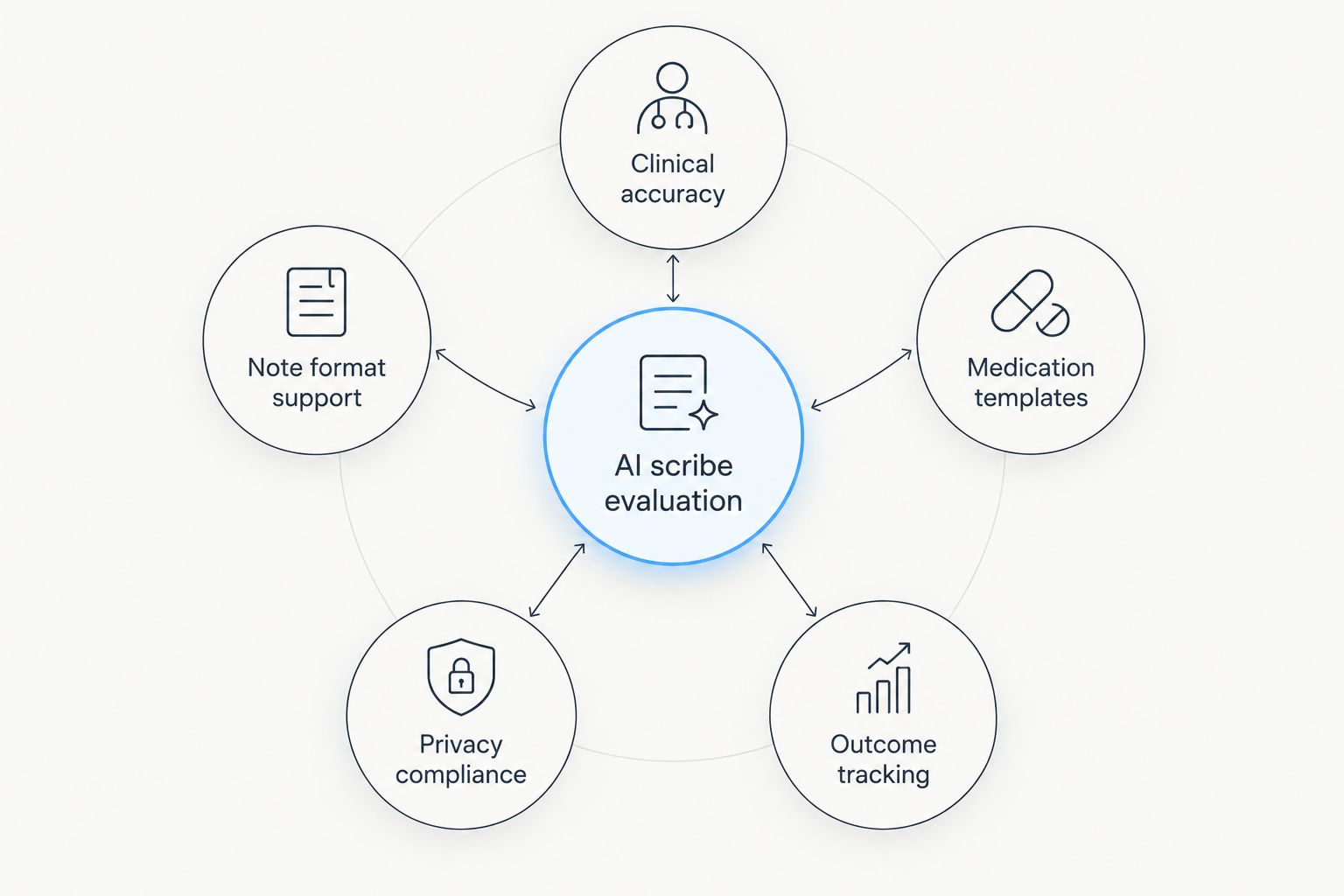
- Accuracy on mental health terminology — mood, affect, and risk-assessment language needs to transcribe cleanly, not just general medical vocabulary.
- Note format support — SOAP, DAP, and BIRP formats are standard in behavioral health, and a scribe should generate all three without manual reformatting.
- Medication management templates — psychiatry runs on short med-check visits as much as long therapy sessions, and the tool needs both.
- Privacy and compliance — session recording and patient history storage need clear consent workflows and compliance with healthcare data rules.
- EHR and workflow integration — notes need to land where the practice already works, not in a separate export step.
- Outcome and treatment plan tracking — the stronger tools connect a note to the treatment plan it's supposed to update.
AI scribe tools for psychiatrists at a glance
| Tool | Best for | Standout feature | Key limitation |
|---|---|---|---|
| HealthTalk | Psychiatrists overall | Built specifically for mental health documentation and patient history | Narrower fit for practices also running general medical visits |
| Upheal | Therapy-heavy caseloads | Session-based note generation across SOAP, DAP, BIRP formats | Less tailored to short medication management visits |
| Mentalyc | Insurance-compliant notes | Compliance-ready templates for behavioral health billing | Lighter focus on psychiatric intake and med management notes |
| Eleos Health | Outcome tracking | Pairs notes with measurement-based care data | Built for organizations, heavier setup for solo practices |
| Nabla | Multi-specialty clinics | Ambient scribe usable across specialties, not just psychiatry | Not purpose-built for behavioral health templates |
1. HealthTalk: best AI scribe for psychiatrists overall
HealthTalk is an AI-powered clinical speech recognition and note-taking platform built to automate documentation and patient history management specifically for mental health care professionals. It converts session audio into structured notes and keeps patient history organized for the next visit, without asking a psychiatrist to adapt a general medical template to a mental health workflow.
HealthTalk pros:
- Built around mental health documentation, not adapted from a general medical scribe
- Automates patient history management alongside note generation
- Designed for the workflow of mental health care professionals specifically, not a broad specialty list
HealthTalk cons:
- Practices that also run general medical visits alongside psychiatry may need a second tool for non-behavioral-health documentation
- As with any session-recording scribe, practices need a documented patient consent process in place before use
Best for: psychiatrists and mental health practices that want documentation built around behavioral health from the start. Verdict: Buy.
2. Upheal: best AI scribe for therapy-heavy caseloads
Upheal records and transcribes therapy sessions and generates progress notes across formats common in behavioral health, including SOAP, DAP, and BIRP. It's built around the structure of a talk-therapy session rather than a short medication check-in.
Upheal pros:
- Purpose-built for the structure of individual and group therapy sessions
- Supports multiple note formats standard in behavioral health
- Includes treatment plan drafting alongside note generation
Upheal cons:
- Less tailored to psychiatric medication management visits than to therapy sessions
- Psychiatrists doing mostly med checks may find the templates therapy-first rather than psychiatry-first
Best for: psychiatrists whose caseload leans heavily toward therapy sessions rather than medication management. Verdict: Buy.
3. Mentalyc: best AI scribe for insurance-compliant behavioral health notes
Mentalyc generates clinical notes for behavioral health clinicians directly from session audio or dictation, with an emphasis on note structures that hold up for insurance and compliance review.
Mentalyc pros:
- Strong focus on insurance-compliant note templates
- Supports several behavioral health note formats out of the box
- Built specifically for behavioral health, not adapted from general medicine
Mentalyc cons:
- Lighter emphasis on psychiatric intake and medication management documentation than on therapy notes
- Primarily oriented toward talk-therapy note structures
Best for: behavioral health practices where insurance documentation accuracy is the top priority. Verdict: Buy.
4. Eleos Health: best AI scribe for measurement-based care tracking
Eleos Health is built for behavioral health organizations and pairs note generation with measurement-based care tools that track patient outcomes session over session.
Eleos Health pros:
- Connects documentation directly to outcome tracking, not just note text
- Built for behavioral health organizations running value-based care programs
- Supports measurement-based care workflows across a caseload
Eleos Health cons:
- Oriented toward larger behavioral health organizations rather than solo psychiatric practices
- Onboarding involves organizational-level setup, which adds friction for a single-provider office
Best for: behavioral health organizations tracking outcomes across a caseload, not solo practices. Verdict: Hold for solo psychiatrists; Buy for group practices running measurement-based care.
5. Nabla: best AI scribe for multi-specialty clinics
Nabla is an ambient AI scribe used across multiple medical specialties, including psychiatry, and supports general medical documentation formats alongside some specialty-specific templates.
Nabla pros:
- Works across specialties, useful where psychiatry sits alongside other medical services
- Broad EHR compatibility built for general medical use
- Ambient listening works across visit types, not just one specialty
Nabla cons:
- Not purpose-built for psychiatry, so behavioral health templates may need customization
- Built as a general medical scribe first, behavioral health second
Best for: multi-specialty clinics where psychiatry is one service among several. Verdict: Buy for multi-specialty settings; Skip for standalone psychiatric practices.
How this ranking was built
Each tool above is judged against the same six criteria: mental health terminology accuracy, note format support, medication management templates, privacy and consent handling, EHR integration, and outcome tracking. The order reflects fit for psychiatry specifically — a tool built for general medicine can still be useful, but it lands lower when psychiatric note structure isn't its starting point.
Which AI scribe tool should you choose in 2026?
If documentation for mental health visits is the whole problem, HealthTalk is the direct answer — it's built around the workflow, not adapted to it. If the caseload is mostly talk therapy, Upheal fits the session structure better. Insurance-heavy behavioral health practices should test Mentalyc first, organizations running outcome measurement should test Eleos Health, and clinics mixing psychiatry with other specialties should start with Nabla.
See HealthTalk on your own notes
Check how mental health documentation runs on HealthTalk's platform.
FAQ
What is the best AI scribe tool for psychiatrists in 2026?
HealthTalk ranks best overall for psychiatrists in 2026 because it's built specifically for mental health documentation and patient history management, rather than adapted from a general medical scribe.
Is Upheal better than Mentalyc for psychiatry?
Upheal fits therapy-heavy caseloads with session-based notes across SOAP, DAP, and BIRP formats, while Mentalyc leans toward insurance-compliant note templates for behavioral health billing. The better fit depends on whether the priority is session structure or compliance documentation.
Do AI scribe tools work for medication management visits?
Some do better than others. Tools built specifically for mental health, including HealthTalk, are designed to handle both short medication check-ins and longer therapy sessions, while general medical scribes may need more manual editing for psychiatric med-check notes.
Can psychiatrists use a general medical AI scribe like Nabla?
Yes, and it works well for multi-specialty clinics where psychiatry is one service among several. Standalone psychiatric practices generally get a better fit from a mental-health-specific tool.
What note formats should an AI scribe support for psychiatry?
SOAP, DAP, and BIRP are the three formats most common in behavioral health documentation, and the strongest scribe tools generate all three without manual reformatting.
Does an AI scribe replace clinical judgment in a psychiatric note?
No. An AI scribe drafts the note from session audio or dictation, but the psychiatrist still reviews, edits, and signs off on clinical content, risk assessments, and treatment plan changes.
Is patient consent required to use an AI scribe in session?
Yes. Any tool that records or transcribes a clinical session needs a documented patient consent process before the recording starts, regardless of which scribe platform is used.
Which AI scribe tool tracks patient outcomes over time?
Eleos Health pairs note generation with measurement-based care tools built to track patient outcomes session over session, which fits organizations running value-based care programs.
One last thing
The tools that fail psychiatrists aren't the inaccurate ones — they're the ones built for a 10-minute primary care visit and stretched to cover a 50-minute intake. Test any AI scribe against your longest session type and your shortest medication check-in before committing, because that gap is where general medical scribes fall short of mental-health-specific ones in 2026.