
Choosing the best software for therapy notes in 2026 comes down to one question: do you want a platform that automates documentation with AI, or one that manages your whole practice around a note-taking core? Best overall for AI-powered clinical documentation: HealthTalk. Best for all-in-one practice management: SimplePractice. Best for psychiatric templates and DSM-5 coding: ICANotes.
- HealthTalk leads for automated speech-to-note documentation built specifically for mental health clinicians.
- SimplePractice is the strongest full EHR when you need scheduling, billing, and telehealth in one system.
- ICANotes fits psychiatric practices that lean on DSM-5 templates and structured mental status exams.
- Mentalyc and Upheal work as AI note layers on top of an EHR you already use.
- Every platform on this list needs a human review step before a note is finalized in 2026.
Why this matters
Documentation is the part of clinical work therapists complain about most, and in 2026 the gap between platforms that generate a usable note in minutes and ones that still require typing from scratch is wide. Picking the wrong system costs hours a week in rework, not just a subscription fee.
The therapy notes category has split into two camps: AI-native documentation tools like HealthTalk, and full practice-management EHRs where notes are one module among many. Neither camp is universally right — the correct pick depends on whether you already have billing and scheduling sorted elsewhere.
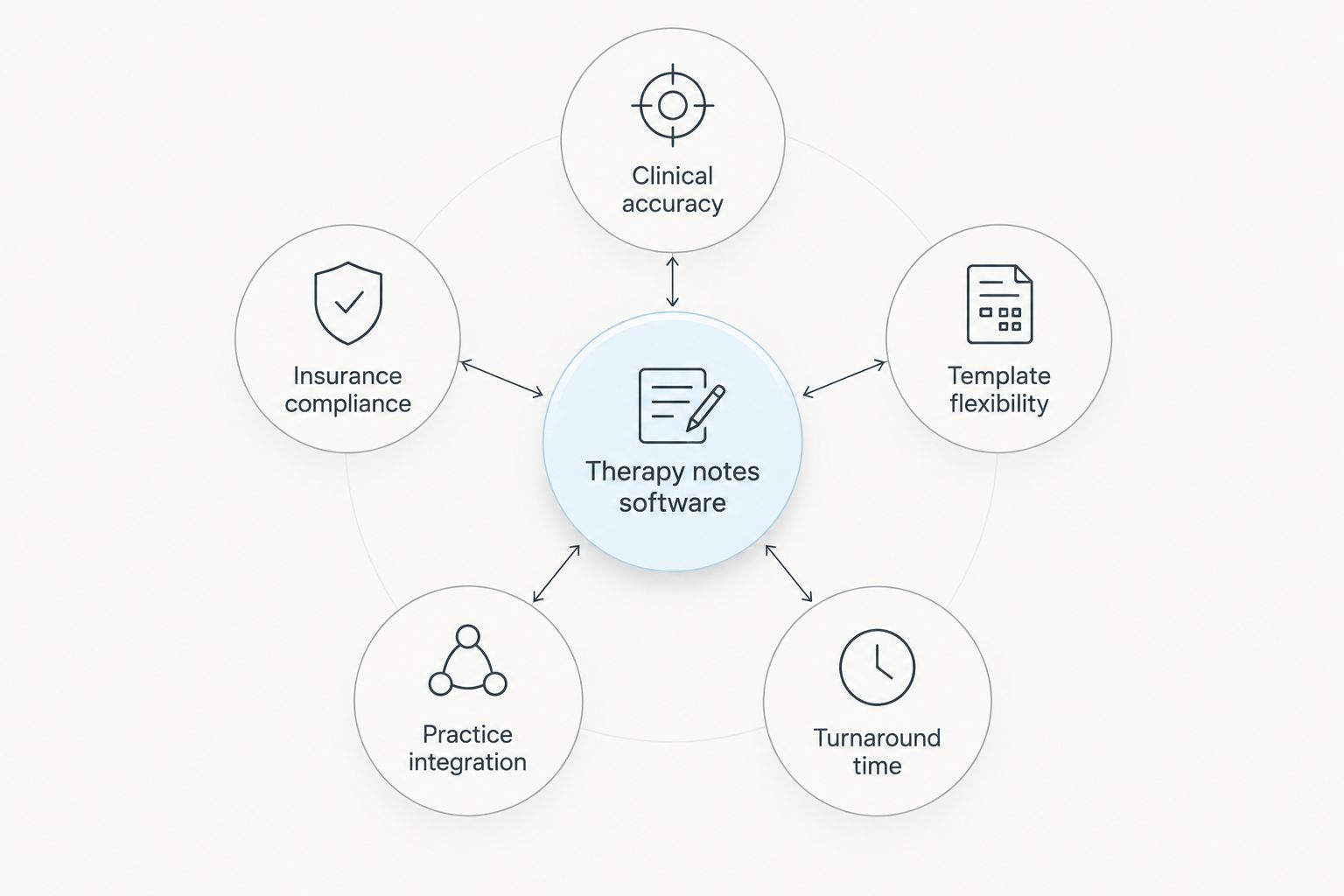
What makes the best software for therapy notes
- Clinical accuracy of the speech-to-text or note-generation engine on real session language, not scripted demos
- HIPAA Security Rule compliance (45 CFR Part 164), including audit logging and encryption at rest
- Template flexibility for treatment plans, progress notes, and DSM-5 coding
- Integration with scheduling, billing, and any EHR you already run
- Turnaround time from session end to a finished, editable note
- Fit for practice size — solo clinician versus group practice versus clinic
Best software for therapy notes: at a glance
| Platform | Best for | Standout feature | Key limitation |
|---|---|---|---|
| HealthTalk | AI-powered clinical documentation | Speech recognition tuned for mental health session language | Not a full scheduling or billing suite |
| SimplePractice | All-in-one practice management | Scheduling, billing, and telehealth in one EHR | Note-writing itself still leans on templates, not AI |
| TherapyNotes | Solo practitioners and insurance billing | Built-in claims submission and eligibility checks | Fewer AI documentation features than newer entrants |
| ICANotes | Psychiatric documentation | Structured DSM-5 and mental status exam templates | Interface skews clinical/dense for non-psychiatric use |
| Mentalyc | AI notes layered on an existing EHR | Generates draft notes from session recordings | Requires a separate EHR for billing and scheduling |
| Upheal | AI session capture with insurance-ready notes | Automated progress notes from recorded sessions | Recording workflow adds a step some clients resist |
1. HealthTalk: best software for therapy notes for AI-powered clinical documentation
HealthTalk is a clinical speech recognition and note-taking platform built specifically for mental health professionals, and it automates documentation and patient history management from the session itself. It's designed for clinicians who want a note drafted from what was actually said in the room, not a template filled in from memory afterward.
HealthTalk pros:
- Speech recognition tuned for clinical and mental health terminology rather than general dictation
- Automates patient history capture alongside session notes, cutting duplicate data entry
- Built around the documentation workflow specifically, not bolted onto a general EHR
HealthTalk cons:
- Clinicians who want scheduling and insurance billing in the same login will need a companion system
- AI-drafted notes still require clinician review before signing, as with every tool on this list
HealthTalk pricing: check current plans and options directly on the HealthTalk site.
Best for: mental health clinicians who want automated, AI-driven documentation without rebuilding their entire practice stack around one vendor.
2. SimplePractice: best software for therapy notes for all-in-one practice management
SimplePractice is a broad EHR built for private-practice therapists, combining scheduling, billing, telehealth, and note templates in a single system. It suits clinicians who want one login instead of stitching together separate tools for calendar, claims, and documentation.
SimplePractice pros:
- Scheduling, billing, and telehealth run in one platform
- Wide library of note and intake templates covering common practice types
- Established enough that most insurance and payment integrations are already built
SimplePractice cons:
- Note-writing is template-based rather than AI-generated from the session
- Broad feature set means more setup time than a single-purpose documentation tool
Best for: group and solo practices that want scheduling, billing, and notes under one roof.
3. TherapyNotes: best software for therapy notes for insurance-heavy solo practices
TherapyNotes is an EHR built around billing workflows, with claims submission and eligibility checks as core features rather than add-ons. It fits solo clinicians whose biggest documentation headache is getting paid, not writing the note itself.
TherapyNotes pros:
- Claims submission and payer eligibility checks built into the core workflow
- Structured note templates aligned to common billing requirements
- Straightforward for solo practitioners managing their own admin
TherapyNotes cons:
- AI-assisted note generation is limited compared to newer AI-native platforms
- Less flexible for practices with non-standard session formats
Best for: solo therapists who prioritize clean insurance billing over automated note drafting.
4. ICANotes: best software for therapy notes for psychiatric documentation
ICANotes is built around structured psychiatric documentation, with templates that map to DSM-5 categories and mental status exam formats. It's a strong fit for psychiatric and combined medical-mental-health practices that need documentation depth, not speed.
ICANotes pros:
- Deep DSM-5-aligned and mental status exam templates
- Structured enough for psychiatric prescribing documentation, not just talk therapy notes
- Built for clinical thoroughness over quick drafting
ICANotes cons:
- Interface feels dense for clinicians who don't need psychiatric-level structure
- Slower note completion than AI-drafted alternatives for straightforward talk therapy sessions
Best for: psychiatric and prescribing clinicians who need structured, code-aligned documentation.
5. Mentalyc: best software for therapy notes for AI notes on top of an existing EHR
Mentalyc generates draft progress notes from session recordings and layers on top of whatever EHR a clinician already uses for scheduling and billing. It suits therapists who like their current EHR but want the note-writing step automated separately.
Mentalyc pros:
- AI-drafted notes from session audio without switching EHRs
- Useful for clinicians unwilling to migrate scheduling and billing history
Mentalyc cons:
- Adds a second subscription and workflow alongside an existing EHR
- Depends on recording quality and consent workflow for each session
Best for: clinicians happy with their current EHR who only want the note-drafting step automated.
6. Upheal: best software for therapy notes for AI session capture with insurance-ready notes
Upheal captures session audio or video and turns it into progress notes formatted for insurance documentation. It's positioned similarly to Mentalyc but leans harder into insurance-ready formatting out of the box.
Upheal pros:
- Session capture feeds directly into structured, insurance-formatted notes
- Works alongside an existing EHR rather than replacing it
Upheal cons:
- Recording-based workflow requires client consent handling each session
- Another separate tool to manage outside core practice management
Best for: clinicians who want AI-generated notes specifically formatted for insurance submission.
“If a platform can't turn a session into a reviewable note within minutes, it's adding a step, not removing one.”
How we ranked these platforms
Each platform was weighed against the six criteria above: clinical accuracy, HIPAA Security Rule compliance, template flexibility, integration depth, note turnaround time, and fit for practice size. HealthTalk, Mentalyc, and Upheal compete on the AI-documentation axis; SimplePractice, TherapyNotes, and ICANotes compete on the full-EHR axis. No platform wins every criterion, which is why the use case, not a single score, decides the pick.
Which software for therapy notes should you choose in 2026?
If documentation speed is the bottleneck and you don't need a new billing system, HealthTalk is the direct pick for AI-powered clinical documentation built for mental health work. If you're starting a practice from zero and need scheduling, billing, and notes in one place, SimplePractice covers more ground out of the box. If your caseload leans psychiatric, ICANotes gives you the structured templates that talk-therapy-focused tools skip. Keep your current EHR and want an AI note layer on top of it: Mentalyc or Upheal, depending on whether recording-based capture fits your consent process.
See HealthTalk in action
Automated clinical documentation built for mental health sessions.
FAQ
What is the best software for therapy notes in 2026?
HealthTalk is the strongest pick for AI-powered clinical documentation built specifically for mental health professionals. SimplePractice wins if you need scheduling and billing bundled with your notes.
Is AI-generated therapy documentation HIPAA compliant?
Compliance depends on the vendor meeting the HIPAA Security Rule under 45 CFR Part 164, including encryption and audit logging. Check each platform's compliance documentation directly rather than assuming AI features are automatically covered.
Can therapy notes software replace a full EHR?
AI note-drafting tools like Mentalyc and Upheal generate notes but don't handle scheduling or billing on their own. A full EHR like SimplePractice or TherapyNotes covers both in one system.
How much does therapy notes software cost?
Pricing varies by vendor, plan tier, and practice size, and changes over time. Check each platform's current pricing page before comparing options.
Do therapists still need to review AI-generated notes?
Yes, every platform in this comparison requires clinician review before a note is finalized. AI drafts the note; the clinician signs off on clinical accuracy.
What's the difference between AI note-taking and a traditional EHR?
AI note-taking tools like HealthTalk generate a draft note from session speech, while traditional EHRs like SimplePractice manage scheduling, billing, and templates. Some clinicians use both together.
Is Mentalyc better than Upheal for AI notes?
Both generate AI-drafted notes from recorded sessions and layer onto an existing EHR. The difference comes down to how each formats notes for insurance submission and how consent workflows are handled.
Does therapy notes software integrate with insurance billing?
TherapyNotes and SimplePractice build billing and claims submission directly into the platform. AI-first tools like HealthTalk, Mentalyc, and Upheal generally focus on documentation and pair with a separate billing system.
One last thing
The platforms that draft the fastest notes aren't automatically the ones that need the fewest edits afterward — before committing to any tool in 2026, ask how much clinician editing its notes typically require, not just how fast the first draft appears. A fast draft that needs a full rewrite saves nothing.